Apophatic
— Pseudo-Dionysius
See the Wikipedia article on Apophatic Theology.
— Pseudo-Dionysius
See the Wikipedia article on Apophatic Theology.
Collins English Dictionary defines interfaith as "relating to, between, or involving different religions."
Two major connotations of interfaith seem to be in tension with each other:
Similar to the word "international", the first is like the Olympics or the United Nations — in which everybody is from specific country. The second is like "international waters", which nobody owns.
An interesting question arises: Does one need to have a "native" religion or spirituality (as with "nationality"), or can "interfaith" essentially be a religious home unto itself (akin to being "multi-ethnic," nomadic or ... a sea creature)? Opinions on that question range from traditionalist ("you need a home base") to postmodern ("religions are illusory constructs").
There are a large number of fancy "meditation apps" in the marketplace these days. They can be helpful for timing your sessions, tracking your activity, and sometimes helping you learn. But buyer beware! Unfortunately, the profit motive behind some of them undermines their purpose. Funded by "private equity," they are incentivized to define meditation as "content," curated by experts, so that they can justify charging a monthly subscription to it. Ironically, that disincentivizes them to teach the simple, natural, content-free meditation recommended by the ancient geniuses of nonduality.
Probably the most useful feature of any meditation app is the timer. It can be very distracting to watch a clock during a timed meditation session. With a countdown timer, you can let go and just be until it chimes for you.
For iPhone users, many of these meditation apps link with the Apple Health App, allowing you to track your "mindfulness minutes" alongside your exercise, sleep, etc.
Here are my suggestions for simple, free mobile meditation apps. They both integrate with Apple's Health App.
But, really any countdown timer will do — on your phone or an old fashioned kitchen timer.
In general usage, samadhi means meditative "absorption," "concentration," or "one-pointedness." It is the state of mind you reach in meditation when you succeed at remaining in single-minded, undistracted awareness.
Samadhi, a Sanskrit term, literally means "to hold things together." The Tibetan equivalent, ting ngé dzin, means "to hold firmly and unwaveringly from the depths so that there is no movement." (Per Rigpawiki)
Sometimes the connotation of samadhi stops at mere concentration. Often, however, it implies deeper states of mind, levels of realization, or nondual wisdom that unfolds within the experience of that meditative absorption. Also, the word "concentration" sometimes does not fit, as some varieties of samadhi have no specific object of attention, or even no fixed reference points at all.
This is another case where a Buddhist term can have conventional/transcendent or relative/absolute senses of meaning. Perhaps it is helpful to differentiate between "big S" and "small s" samadhi.
For a deep dive, see Samadhi on Wikipedia.
Sangha is a Buddhist word for spiritual community — one of the “three jewels”, along with Buddha (Awakened Being) and Dharma (The Teaching). Traditionally, this “third jewel” was the monastic community. More colloquially, that meaning has spread out to include the broader community of Buddhist practitioners and devotees.
Nowadays, sangha often appears in interfaith vocabulary. In the most general sense, sangha can mean any group of spiritual friends or contemplatives who meditate together, study spiritual teachings, and support each other on the path. In this sense, practicing together is what makes a group a sangha, no matter how diverse the backgrounds or beliefs of its membership.
There are individual "sanghas" — specific groups, with particular histories, identities, doctrines and norms. You might have to formally join (or at least show up someplace) to become a member of one.
There is also just Sangha — the one Universal Sangha of all who walk the contemplative path — past, present and future. You automatically belong to this Sangha the moment you aspire to the path, or find yourself on it.
The seven-pointed posture (also known as The Posture of Vairocana) is a traditional explanation of how to sit in Tibetan Buddhist meditation.
The seven points, with some added commentary based our modern-day knowledge of physiology, are as follows:
It is named after Vairocana Buddha, one of the Five Wisdom Buddhas.
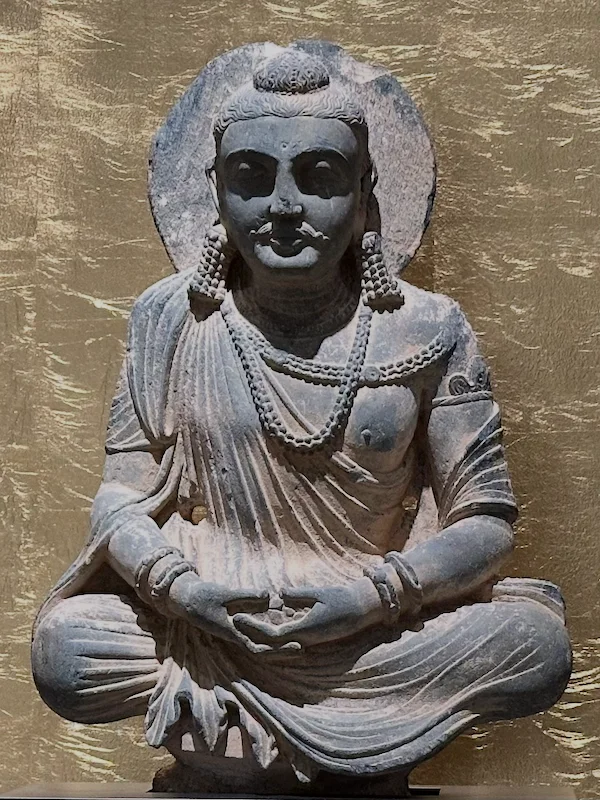
* Here's an example of hands in a "cosmic mudra," from a statue in Berlin's Asian Art Museum:

Spiritual friendship is central to contemplative spirituality – especially in an interfaith group, forming bonds of community where there is no common foundation in doctrine, religious language or heritage.
In the contemplative branches of the world religions, friendship is frequently cited as an essential source of support, empowerment and accountability along the spiritual path. Buddhism sees kalyanamitra, or "admirable friends", as essential to progress on the journey to enlightenment. Sufi poetry exudes friendly sentiments. And in Christianity, similar value is placed upon koinonia — a Greek word for how the Holy Spirit flows through the fellowship, communion and participation of the gathered community.
Spiritual friendship is also a key aspect of spiritual direction, which is often called "soul friendship," "spiritual companionship," or "anamchara"(Celtic for "soul friend".)
Spiritual friendship is part of what makes a religious community a true community, a true sangha, and not just a bunch of people.
Here are some quotes I gathered related to the Mahamudra term "suchness":
All the Victor’s teachings, be they sūtras or tantras, teach the methods for realizing suchness, the abiding state of phenomena. The intention of his teachings is to lead us to suchness. The culmination of practice ends up being suchness. All his instructions, no matter what mode they are, profound or vast, are directed towards suchness.
— Dakpo Tashi Namgyal, Moonbeams of Mahamudra
Śāriputra, someone who cultivates the samādhi of suchness for just [the amount of time it takes] to snap their fingers increases their merit more than someone who listens [to the dharma] for even as long as an eon. Śāriputra, it is for this reason that I strenuously recommend this samādhi of suchness to others.
— The Sūtra Revealing Suchness
Meditate with certainty that everything, inanimate and animate, grasses, twigs, vines and all, have no other nature than your own: genuine suchness.
[...]
Like the way a river’s current flows or a candle’s flame is bound, yogins and yoginīs remain continually in the yoga of suchness, day and night.
— The Hevajra Tantra
The importance of remaining in naturalness is inexpressible.
This is the mother of all buddhas of the three times.
— The Tantra of Nonabiding Suchness
...Wise people who are immersed in genuine being,
Aware of reality and [its] ineffability,
Are free within the Expanse,
The suchness in which there is no causality.
— Longchen Rabjam, The Precious Treasury of the Way of Abiding
When you realize your own suchness, even the distracted mind is mahāmudrā.
— Saraha